Wednesday, 29 December 2010

Is that all there is?


No matter how much I try to spiritualise Advent and Christmas the results are always the same. When it finally arrives I heave a huge sigh of relief knowing that I have once again made the midway marker that divides the end of the silly season from the beginning of the Great New Zealand Melt Down. A sort of religious half way house where I can momentarily catch my breath before packing up the camping gear, squashing the family into the car and heading north - the only direction one can go by road if one lives in Wellington. That’s how Christmas has always been for me, but this year I found myself sympathising with the sentiments in Peggy Lee’s song, ‘Is that all there is?’[1] . . . ‘Is that all there is?’

Long before there was a Christmas day, the 25th of December was the mid way marker between the dark days of winter, and the promises of spring. It was a mid winter feast the Romans called festus solis invicti, - the festival of the unconquered sun. When Christianity became the official religion of the Roman Empire, the imagery of the invincible sun breaking forth out of winter darkness, and the invincible Son breaking forth out of the darkness of sin was obvious. The symbolism just seemed to shout it without the necessity for words to join up the dots. The festival of the unconquered sun became the festival of the unconquered Son, and nature underscored the theology it implied.

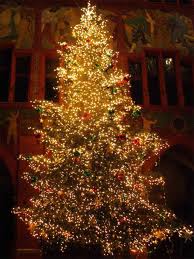
Personally I’d love to do Christmas like that, but the truth is I live in a capitalist culture, in the land of the ‘Upside-down Christmas’ [2]where the seasons give me a very different message. So, try as I might to exempt myself from the Santa Claus face of Christmas and immerse myself in purist liturgy, I can’t. Unless I spend Advent in a monastery, I’m probably doomed to be washed along with the commercial Christmas tide (no pun intended) and to repeat my previous Christmas failures again and again – like Ground Hog Day.

But if I can’t change the culture or the season, perhaps I can change the focus of the feast. What if, for example, instead of just celebrating the memory of the birth of a child, I celebrate the eternal gifts, which that child’s birth guarantees? Gifts of light (Lk2:10-14), gifts of joy (Jn1:3), and gifts of liberation (Mat 11:2-11), to name but a few.

Doing this, won’t change the commercial chaos and general holiday-mania from going on all around me, but focusing on what Jesus brought, rather than simply recalling his coming will change my perception of it. It will change my once a year ham and turkey feast into a 365 day a year feast. One that celebrates an ever-present lighting of my way, an ongoing sense of joy and gratitude for the good things God has given me, and a growing awareness of my personal responsibility to ensure that the society in which I live is just. A society where all can share equally in the good things Christ’s birth guarantees.

By all means let us enjoy and celebrate our ‘Upside-down Christmas’ holidays, but let’s not forget what we are celebrating, and that the message of Christmas extends well beyond the festive season.

For me, I need to remember that the commercialism surrounding Christmas is not all there is, just a pointer to the greater reality of the festival of the unconquered Son who brings light, joy and liberation, not just on Christmas day, but 365 day a year.

Yes Christmas is a feast, a feast of Light, a feast of love, and a feast of liberation for all.

1] Is that all there is – written by Jerry Leiber and Mike Stoller Recorded by Peggy Lee August 1969.

[2] An Upside down Christmas, A New Zealand Christmas Carol by Shirley Murray

Read more!

Monday, 29 March 2010

Perfect peace is at best fleeting and at worst, an illusion!


It was lunch time, so I found myself a sheltered spot in the garden and sat down to enjoy a few moments of autumn sun. The weather over the last several days had been less than perfect, and the busyness of the lead up to Holy Week had caught up with me. The peace, the quiet and the warm sun on my face were the perfect antidote to the stresses and strains of everyday life.

Like someone who had just climbed to the top of a high hill, I decided to sit down and enjoy the view (metaphorically) for a few moments before moving on.

Perhaps it was the pastoral conversation I had just had with an elder lady in hospital who was looking back over her life because of declining health, and facing some tuff decisions about her future. Or perhaps it's just something one does naturally relaxing in the noon day sun, but pretty soon, like Alice, I found myself falling down the rabbit hole and to day dreamingly review my own past, looking at where I'd come and who had traveled with me. As I did the years (and decades) fast forwarded themselves: like the individual cards did when you turned the handle in a 'what the butler saw' slide show in an old amusement arcade. Individually they were all still shots, but viewed in succession they appeared as a movie.

It's something I've done often before but this time it was different. For the first time the memory cards seemed to show a seamless integration of past and present. There were no bits that I'd rather have left as 'cuts' on the editors floor, no bits I'd have wanted to send to technical boffins in post production to 'gloss up' on, no scenes I'd rather have re shot. There was no hierarchy in the actors cast either, big part or small part, all were significant and deserving of an Oscar. In short, nothing I would have changed.

Was it a daydream, or was it reality? Only time will tell, but in that moment all the pieces of the jig saw called 'My Life' seemed to fit perfectly, from as far back as I can remember, to as far forward as I can imagine.

Having put the world to rights an unexpected series of phone calls, unscheduled visitors and an assortment of interruptions has left me once again feeling scattered and in need of a fresh daydream.

Seems perfect peace is at best fleeting and at worst, an illusion!

Read more!

Tuesday, 16 March 2010

Wating for a wave


My Great Uncle Jock was born in Clairville, a small south Wairarapa town in the house his father Charlie had built in the late 1800's. A home from which he went to school, met and married his childhood sweetheart, took over the small family farm, raised his children, played with his grandkids and where he finally died: all within a few hundred meters of the house he was born in.

He was a Wairarapa man. He know who he was and where he belonged.

I on the other hand , was born of depression parents eager to take every opportunity that presented itself, no matter where. By the time was 10 I had lived in 6 houses and attended 4 primary schools. Just as I was beginning to fit in and make friends I moved on. By my very early 20's the number had grown to 7 schools,10 houses and I had visited more than 12 countries. By 60 it was more than 50 countries.

I knew where I was born, but unlike Gt Uncle Jock, I had no real sense of where I came from or where I belonged.

One of the most settled periods in my early life were my teenage years which I spent in Otaki and where I learned to surf during the summers of 59-63. As a surfer I would spend hours sitting, often alone, just beyond the breaker line, watching the swell and waiting for 'the' wave. I learned very quickly that waiting for the right wave, as opposed to taking the first wave, vastly improved my level of success and my enjoyment of the ride. I would watch as the waves began to form a few hundred meters away from me and try to pick the one that would be capable of taking me up in its swell and delivering me all the way to the shore. Timing was everything and when the right wave showed up I would paddle furiously, and If I had chosen correctly, the ride would be worth the wait. All waves were not created equal, and more ride for less paddle was my aim.

Like my youth, Otaki became a diminishing speck in the rear view mirror and lost in the blurr of life. But the sense of timing I learned surfing had become part of me and the analogy of 'waiting for wave' became one I resorted to often, even when my surfing days had long since ended. I would often describe my situation as waiting for a wave'; a wave of energy, a wave of inspiration, a wave of enthusiasm, support or what ever. Waiting for the right moment seemed to shorten the odds and meet my criteria of more ride for less paddle: but there was a price to pay. Because of this approach I spent more time on the outside of life looking in than on the inside of life looking out: and I spent much of today waiting for the right wave I knew would come tomorrow.

I had become very adept at sitting just beyond the breaker line of life, often alone, waiting for a wave. It had become a way of life. The paten continued and I became very good as spotting the potential in a situation, often long before others did, and in knowing how and when to paddle in time to catch the natural swell that would ensure I could ride it , , , right to the shore. Im not complaining, the 'talent' I had developed allowed me to do more things than most people would ever dream of doing. I was supremely happy, but unlike Jock I didn't really know where I belonged . . . except possibly in a place called 'mid life crisis.'

I was emotionally stateless, just an elderly surfer waiting for yet another wave.

The Otaki school reunion last October turned out to be a bigger wave than I expected, in fact, I hardly noticed the 'swell' that just visiting old haunts and meeting old friends had begun. But a swell it was, and I noticed bits of my identity floating all around me. There was no cohesion, no clear sense of anything like Jock's identity with his place of origin, but slowly over the last several months, I've watched the 'swell' gathering together the fragments of my whakapapa (?): I am John, I come from Otaki. my people are those I knew and grew up with in the late 50's and early 60's, my whenau are my wife, my children and grandchildren, my mountain is Hector and my river the Otaki.

It's not as strong ad Jock's identity, but its a beginning, an anchoring point, a point from which I can begin to grow.

It may have taken sixty something years but I now know who I am - and where I'm from.

Read more!

Friday, 30 October 2009

Perception is reality . . . or is it?


Suppose several of us witnessed something horrific, like a train crash say, or perhaps a road accident.

And if we were all asked, several weeks later, to write an account of what we'd seen, do you think all of these accounts would be identical? And if not, would one be the truth and the others lies?

Or would each simply represent differing interpretations of the same reality viewed from differing perspectives by different people?

Looking back at my life as a teenager I very clearly saw myself in those days as insignificant and lacking in either personalty or confidence: a Mr Cellophane character, noticed at best by no one, at worst, overlooked by all. Over the years I've grown past that early adolescent image of myself (or at least, learned various coping mechanisms to mask it), but perception was reality and beneath the mask, I knew beyond doubt that I was a social failure.

With this knowledge lodged firmly at the forefront of my mind, and my most confident smile masking my insecurity, I headed off for the Class of 59 reunion: trying hard to blend unseen into the atmosphere of the cocktail lounge (read gymnasium).


Conversations I was apart of usually went something like this . . . .

“Smith " (name changed to protect my anonymity) you old b#&^*rd' you haven't changed a bit. I'd have recognised you anywhere!

Remember the time . . . “, and then would follow a story full of life and punctuated with humour. A story I would recognise, but one in which I'd seen myself as the monochrome coloured extra rather than the center stage star of this action packed replay of someone else's memory of my past. A story where the facts were all there, but not quite as I had remembered them.

Clearly their recollection of our childhood days were at odds with mine, so one of us must have the wrong end of the stick. Or did we?

Could it be the same reality viewed from differing perspectives by different people?

But if so, which was the correct version, theirs, or mine? I certainly preferred theirs: but perhaps they were just as surprised by my remembrances of them? Perhaps their adolescent self image was about as shaky as mine?

Anyway several such encounters, and a glass or two of wine later, I felt myself walking noticeably taller, with a definite spring in my step and humming the old school victory song.

Reunions, I've decided, are a great opportunity to re write some of those old scripts that for some of us, are still running our lives 50 years on .

Read more!

Monday, 12 October 2009

On the doorstep


Several months ago I heard of the 50th anniversary of my old secondary school - and it got me thinking.


I thought back to that morning in February 1960 ( I can't remember the exact date) when I dressed, put on my cap picked up my school lunch and headed off out the door, just like I'd done day after day for the 8 years that had preceded it.

But as I rode my bicycle toward the gates of my Secondary School for the first time, I was unknowingly crossing the doorstep from childhood into the training room of life. A place where, over the next few years, I would learn not only academic truth but, more importantly, a place where I would absorb important truths about life. Values and attitudes that would shape me as an adult: intangible things like, an enquiring mind, confidence, a work ethic, a concept of responsibility, societal values such as etiquette the importance of team contribution, first love, etc. etc. A worldview which I would gathered eclectically, recklessly, taking from here and there what ever took my teenage fancy. Like a hungry man at a lavish smorgasbord, piling my plate with much more than I could possibly eat. A plateful that would shape my future, a starter kit for the rest of my life.

And so here I stand at 63 on another doorstep. The doorstep of what is popularly called the Second half of Life. Standing here with a worldview built by a 13 year old, and largrely unreviewed over the past 40 years.

Eric Ericson, the father of developmental psychology, who coined the now famous phrase,'identity crisis' speaks of this second half of live as a time when life challenges us to integrate our 40 year old, eclectically gathered worldview into the reality of our post family, post career, pre pensioner life. The fruit of this pleasurable/painful exercise, he assures us, will be self acceptance, contentment and inner peace,.

I'm not terribly advanced on this new journey toward a peaceful integration of myself, but I have realised that I'm on the doorstep of the last frontier and a doorway to self knowledge and acceptance.

And I thought midlife crisis was the last big hurdle.

Dream on John!

Read more!

Sunday, 6 September 2009

Should we be allowed to die because we are poor?


I've been following Barak Obama's argument for affordable health care and I agree, access to essential social services is a basic human right and provision of these services is the responsibility of government, not private enterprise.

Of course commercial interests within the U.S. healthcare industry strongly disagree, but then health care is big business for them.

We can see the seeds of Obama's argument mirrored in our own recent history. Less than a generation ago all NZ's social services (including free healthcare) and our nations infrastructure (roading, power, transport, communications etc) were publicly owned. These enterprises didn't make a profit but they weren't meant to. They were run by government, supported by our taxes and their purpose was to offer affordable social services to all, and to ensure near full employment.

Then overnight it seemed, most of these activities of government were privatized. Sold off to big offshore companies who promised us greater efficiency and higher profits. However we failed to see that greater efficiency would be brought about by cutting jobs and higher profits through increased consumer costs.

To use John F Kennedy's words, "the fruits of our victory turned to ashes in our mouths".

Surely the bigger question Obama's argument raises though, concerns the responsibility of government: is it to the tax payer or to big business and CEO bonuses?

Maybe Obama is trying push back the hands of time, but isn't it time somebody did?

Read more!

Saturday, 13 June 2009

Rabbi Froman believes settlers should be prepared to live under Palestinian rule

extracted from an article published by the BBC Jerusalem correspondent


Rabbi Menachem Froman
Rabbi Froman believes settlers should be prepared to live under Palestinian rule

"We are now in the Holy Land, the Land of the Lord", says Rabbi Menachem Froman welcoming us to his modest house in the tiny settlement of Tekoa in the West Bank.

With his long beard and a black suit, the rabbi looks like a typical religious settler. In fact he is more than a settler, he is one of the founders of the settler movement. Moreover, he believes that settlements like his can be a vehicle for peace.

The rabbi is part of Jerusalem Peacemakers, an interfaith project with an aim to facilitate dialogue between the Jewish and Muslim community.

And the dialogue which Rabbi Froman is engaged in would shock most Israelis: he was close friends with the leader of the Palestine Liberation Organisation, Yasser Arafat, and used to visit Sheikh Ahmad Yassin, the late founder and spiritual leader of the militant Hamas group, at home in Gaza and later in his Israeli jail cell.

"From the very beginning it was very clear to me that you cannot love the country, love the rocks, the trees, the valleys, and hate the people living here," says Rabbi Froman.

"Two thousand years ago one of our sages, Rabbi Hilel, was asked to explain the essence of Judaism while standing on one leg - in other words, in a very short time. And his answer was: Love your neighbour. Every Jewish child learns this story at school. And this is what I am doing here today."

Rabbi Froman says that those settlers who love the Holy Land should be prepared to live under Palestinian rule - not as occupiers under the heavy protection of the Israeli army.

More than 300,000 Israeli settlers live in the West Bank, in addition to about 200,000 in Israeli-occupied East Jerusalem, and the vast majority are opposed to a Palestinian state.

They dismiss the rabbi's views as irrelevant. But other Israelis often admit there is logic to this unorthodox solution to the question of Jewish settlements.

Celebrated scholar

Rabbi Froman's views are shared by another unorthodox peacemaker: a Palestinian Muslim sheikh who lives in the heart of the Old City of Jerusalem right next to the compound known to Muslims as the Noble Sanctuary and Jews as the Temple Mount.

"No one can live here as an occupier," says Sheikh Abdulaziz al-Bukhari, an exponent of the mystical Islamic Sufi movement. "We are in the 21st century, we do not live in a jungle any more."

Sheikh Bukhari has modern views, though his family roots go back to the ninth century. He is a descendant of the celebrated Islamic scholar Imam Bukhari.

Sheikh Abdulaziz al Bukhari
 When I was in South Africa and I spoke to Nelson Mandela, he told me he thought he would never see the end of apartheid. But he did 
Sheikh Abdulaziz al-Bukhari

Centuries-old books on Islamic theology written by his ancestors are proudly displayed in the sheikh's living room.

His family left Bukhara, in modern Uzbekistan, about 400 years ago, and has been living in the same house in the Old City ever since.

Sheikh Bukhari admits that he often finds opposition within his own community.

"When someone is angry, you don't shut them up, you let them speak, let them open their heart", he says.

"And then I say, OK, what other choice do you have? To fight? We have been doing this for 50 or 60 years, and we haven't achieved anything".

Sheikh Bukhari's commitment to peace was tested in this December and January during Israel's three-week military campaign against Gaza, Operation Cast Lead.

His wife's family lives in Gaza, so does his sister and one of his daughters. "No-one knows what I was going through. There was a real drama in my heart", he says.

Peace a possibility

Middle East peacemaking projects are at low ebb right now. With mainstream Israeli politics shifting to the right and far right, and Palestinian public opinion still enraged by the Gaza campaign, most analysts admit there is little scope for peace work.

"Rabbi Froman is well known, and he is serious", says Kitty Cohen of the Institute for the Study of Religions and Communities in Israel.

"I wish more people inside political establishment listened to him."

As for Sheikh Bukhari, he is careful to maintain relations with the Israeli authorities, which in turn alienates many potential Palestinian supporters who see his work as legitimising the Israeli occupation.

Sheik Bukhari's books
Bukhari draws on Islamic texts to support his views

Despite the recent shock of the Gaza campaign, Sheikh Bukhari firmly believes peace is a real possibility.

"I believe it can happen next week and definitely within my lifetime. Believe me, life brings surprises. When I was in South Africa and I spoke to Nelson Mandela, he told me he thought he would never see the end of apartheid. But he did."

Rabbi Froman is equally optimistic. He says his conversations with Sheikh Ahmad Yassin convinced him that Hamas may turn to peace.

"I see a real possibility that Ismail Haniya and Khalid Meshaal may return to their Islamic roots", he says. "Islam is a religion of peace."

Most peace activists here are hoping that President Barack Obama's new policies on the Israeli-Palestinian conflict and his recent speech in Cairo will initiate a meaningful dialogue.

If it happens, voices like that of Rabbi Froman and Sheikh Abdulaziz may become more prominent.

"In the meantime", says Rabbi Jeremy Milgrom of Rabbis for Human Rights, "the warm presence of these people is a great encouragement to the rest of us."

By Dina Newman 
BBC News, Jerusalem


Read more!

Wednesday, 27 May 2009

Getting it together.


Looking back, the last time I had my act together was just after I was born. 


Then I was at peace with myself and my surroundings, 


Then I had no fears, no worries, no  concerns.


Then I  didn't have to look good, be right, justify myself, wonder what was in it for me,  or worse, what was in for for them?. 


I was trusting and open then, I was  content and I didn't have to defend my actions. 


Then I was just me, whole, perfect and complete. 


Like the scriptural birds of the air, 'I sowed not, neither did I reap yet my heavenly father provided all I needed.'


As time went on though, I learned better.  


For instance , if I woke and mum wasn't there all I had to do was cry and she'd come and pick me up.


And if that's not what I wanted 

I could cry louder and she'd examine my needs more carefully till she discovered exactly what it was I wanted. 


I had power. 


And I learned other things too; 


dogs were scary because they were big and might hurt me, 


If i was good I got special treats, 


if I was funny people laughed. They liked me when I was funny but I wasn't sure about dad. 


I don't think dad liked me. He was never there, and my school teacher was always crabby. 


You can't trust crabby people. Better to keep quiet and out of sight. 


And strangers must be very dangerous. Every one tells you so. I think I'll stay well clear of people I don't know. 


Piece by piece I was building a new reality about who I was and how best to survive in this hostile world. 


A matrix which would set the parameters of what was, and was not possible for me, would define who I was. 


A matrix that, if I stayed within its boundaries would keep me safe. 


Being whole perfect and complete was no longer what I was, but what I might become - in time, if I really worked on it.

Read more!

Friday, 24 April 2009

Easter, a time for remembering

Easter is all about remembering. Remembering Christ's Passion, remembering his death, remembering his resurrection, and remembering the forgiveness of our sins. But how does the Biblical concept of remembering differ from say, remembering our last visit to the beach, or remembering our phone number?

When we celebrate Eucharist, the Prayer of Invitation prayed by the Priest calls us to 'receive  . . .  in remembrance that Christ died for us'.  Here the word remembrance draws on the ancient  Greek concept of 1Anamnesis, a term that implies a far deeper meaning than simply recalling something to mind. Aanamnisis should be more properly understood as doing again, making present or renewing.  When scripture tells us that  'God remembered His promises to Abraham, for example, it doesn't simply mean he recalled his covenant to memory, it means he actually made it present again, and renewed its power in the lives of his people

Our own understanding of this spiritual concept deepens every Easter as we considered the story prior to Calvary, back to the Exodus and explored the linkages between Passover, the Seder (the post Egyptian form of Passover) and Eucharist, all of which major on anamnisis or remembrance.

The Passover which Jesus shared with his disciples remembers the flight from Egypt (Exodus 12) where the Israelites slaughtered an unblemished lamb and place its blood on the doorposts and lintel on each house. That night  when the angel of the Lord travelled through Egypt only those houses with the lamb's blood on their doorposts would be spared. The annual anamnisis of this salvivic act of God became embodied in the Seder, an intergenerational ritual meal where family and friends gather in obedience to God during Passover, to remember the events  of their salvation history. Through this meal of anamnisis, each successive generation became grafted into Israel's story, and God's promise became personal to each, even though they were not even born at the time the promises were made. 


It was at this meal of anamnisis that Jesus celebrated what many Christians now call 'The Last Supper' with his disciples. (Mk 14:12-16; Lk22:17-20; 1Cor 11:23-25) 


At that meal there would have been three pieces of unleavened bread to anamnisis the promises made to the three patriaches, Abraham, Isaac and Jacob, and four cups of wine to anamnisis the four distinct redemptions promised by God (Exodus 6:6-7):  "I will take you out of Egypt",  "I will deliver you from slavery",  "I will redeem you with a demonstration of my power", and "I will acquire you as a nation".  

There would also have been a fifth cup of wine called "The Cup of Elijah." This cup is poured as part of every Seder, but never consumed. Instead it is reserved for the Prophet, who scripture tells us is to herald the coming of Messiah at Passover, one day.  

During the meal, the first piece of unleavened bread is blessed and  a portion of it is torn off and reserved in a linen napkin alongside the Elijah cup. It is called the afikomen, a Greek term, that means 'for what (or for whom) is to come'. 

The afikomen is not consumed as part of the meal though the reason seems to have become lost, but at the conclusion of the Last Supper, all that would have been left on Jesus' table would have been the Elijah cup and the afikomen. 

When the words of the liturgy tell us that, 'after supper, Jesus took the cup/bread', these are the very elements he would have taken, blessed and entrusted to us to anamnisisise him.  

Being well schooled in Hebrew Scriptures and tradition, the significance of Christ's actions and words would have been very clearly understood by all present in the room. They were an unmistakable statement, almost shouted, by Jesus  that he was Messiah, and that the promises made to Israel through the patriaches  would pass on in perpetuity, to all who believed in him, through this new meal of anamnisis, the Eucharist, and that there was now 'neither Jew nor Greek, Slave nor free, for we are all one in Christ Jesus.'  (Gal 3:28)

 So, just as each successive Jewish generation incorporated itself into God's promises each Passover, so we who live under the New Covenant graft ourselves into the same story as co-inherit-ants of all God's promises through our remembrance of Easter, and the salvation Christ  won for us.

Anamnesis is not a simple intellectual function; it is an action (it) does not simply refer to the past, it makes present the past and the future.

As members of the eucharistic community we recall again to consciousness the economy of God in Christ through the Holy Spirit, the incarnation, the crucifixion, the resurrection of Christ, his ascension, and Pentecost. We live them. 3

Anamnisis is not just a word, it's what church does.


Read more!

Thursday, 2 April 2009

Credit Crisis for Dummies


Call it simplistic if you like but here's how it looks to me.

As the West moved from a land based to an industrialised economy, labour followed. Mining, heavy industry and manufacturing formed an equitable partnership providing profit for the investor and meaningful work and dignity for the workers. Urban workers needed essential goods and capitalism needed producers. The perfect partnership.

A period of affluence followed, richer workers became shareholders and shareholders, hungry for profit, moved manufacturing off shore to cheaper labour markets, Workers in the west became educated, stopped producing and began managing the process of global production distribution and sales. However as well as producers, capitalism needed consumers and production was fast outstripping consumption. Answer, the credit industry.

A stimulated investment industry talked up the value of shares and real estate against which to secure it's credit advances thus providing more and more consumers with more and more spending power to consume more and more goods and services. But the new talked up values were confidence rather than reality based, and the result: was an international credit blow out.

Answer? Run the same scenario in the developing countries where manufacture (but not consumption) is now centered. Offer them the credit they need to become consumers instead of simply producers. That should fix the problem, at least in the short term.

Have we really got the keys to the asylum, or have we given them to the financial inmates?

Read more!

Thursday, 26 March 2009

Is it about winning, or about how you run the race?


Like most of us, I grew up learning fairly quickly how to win attention and approval, and by the time I was 5 I'd rehearsed it into an art form.

With out even trying, my young sister was working steadily on her own 'winning formula'. It was very different from mine but equally as effective. Being a petite curly headed blond with the gift of the gab, her tactic was to be cute and engaging: and it worked, every time!

Mine on the other hand (probably to gain my fathers approval) was to be enquiring and decisive as I knew these were qualities he admired. It was my winning formula and kept me ahead of the game and in control. And because it always worked, I applied it time after time after time after time. Where she played the cute and chatty card, I won my battles by being enquiring, decisive and quick to act.

But just because you have a winning formula (we all do incidentally) doesn't make it the best strategy for us. Taken to extremes, my sister risked being perceived as a bit dizzy and shallow (which she isn't), and I of being seen as cynical and closed to others input.

So if an habitual strategy learned as a child the isn't the best formula for an adult, then I need to ask myself why do I continue to allow a 5 year old to run my life? Surely there's a better way?

For me there is. It involves a deliberate decision to be open to the possibility of living a life where I'm instinctively positive and open to council. And by giving you (& all my friends, acquaintances and family) permission to let me know if I'm falling back into old my ways.

Will it change anything? I believe it will, but this way you'll be the judge, not me.

Read more!

Tuesday, 3 March 2009

Jimmy Carter had the right idea


James Hider's article, 'Single state solution edges nearer' (Dompost 3/3/09) may be revolutionary but its by no means a new idea dating back to the MacDonald White Paper of 1939. Raising it again now does however expose the dilemma currently facing Israel.

Under military occupation, the Jewish State has laid claim to much of Palestine, built extensively on it and secured it's hold over its west bank settlements by force. Huge steel walls and military check points honeycomb much of the landscape, leaving only discombobulated pockets of land, separated from each other and entirely dependent on Israel's good will for the provision of water electricity and sewage disposal.

Not much of a bargaining chip to offer Palestine by way of compensation.

Maybe its time for Israel to grasp the nettle. Separated development did not work for South Africa and will not be any more successful for Israel. To quote President Jimmy Carter, 'Unless both sides win, no agreement can be permanent'

Read more!

Tuesday, 24 February 2009

Gaza conflict: Who is a civilian?


The Interior Ministry was hit in the first strike targeting a government building

The bloodied children are clearly civilians; men killed as they launch rockets are undisputedly not. But what about the 40 or so young Hamas police recruits on parade who died in the first wave of Israel's bombing campaign in Gaza?

And weapons caches are clearly military sites – but what about the interior ministry, hit in a strike that killed two medical workers; or the money changer's office, destroyed last week injuring a boy living on the floor above?

As the death toll mounts in Gaza, the thorny question is arising of who and what can be considered a legitimate military target in a territory effectively governed by a group that many in the international community consider a terrorist organisation.

This is also the group that won the Palestinian legislative elections in January 2006 and a year later consolidated its control by force.
So while it was behind a campaign of suicide attacks in Israel and fires rockets indiscriminately over the border, it is also in charge of schools, hospitals, sewage works and power plants in Gaza.


Read more!

Wednesday, 11 February 2009

Looking at the bigger picture

'A text out of context is merely a pretext'.

We all do it. We extract a single core element of truth, (the text) and ignoring every other argument that surrounds it, (the context), build a thesis upon it.

Politicians do it all the time. Mutter mutter 'weapons of mass destruction'; mutter mutter 'terrorism/security/terrorism'. etc. Journalists do it by focusing on the sensational at the expense of the background. Religious scholars who are past masters at it, having done it for 2,000 years, have made it an art form and earned the title 'fundamentalist.' But whatever name it goes by it distorts a truth by ignoring the bigger picture that surrounds it.

But what about us, the little people. Your every day man or woman in the street, are we exempt from this practice in our mundane daily lives?

I don't think we are, I think we do it with our memories: our selective recollection of whatever.

For example, something traumatic happens, a redundancy perhaps, or the death of a loved one, and instinctively we focus on the loss we have experienced, the smaller picture, the text. We defend ourselves and allocate blame, we become angry or perhaps, unable to face the enormity of the situation, so we pretend we're coping OK, but are often just in denial.

These are all perfectly normal responses which hopefully, help us move on,  eventually, to a state of healthy acceptance. But often many of us never get over 'it' because we never talk it through, debate it or look at the wider context instead of just the text.

Let me explain. Recently I began a Progoff Intensive Journalling Exercise called 'The now period'. The rules are simple:

1/ Describe the 'Now' period of your life: an open ended period that has a beginning but no ending. Example be, 'It began 4 years ago when I was made redundant . . . '
2/ Record your feelings, thoughts, memories - what ever presents itself. Complete the phrase , "It's a time when . . . .; record images and describe the period.
3. Describe more details about this period: people,projects, activities, your health, attitudes,events, dreams, images, people who inspired you and choices or decisions you had to make.
4/ Read back what you have written and record how you feel about what you have written.

What I found when I did this was that many of the older episodes in my story had been well worked through, and I was completely comfortable with them: grateful for them. But in the more recent period there were stories (episodes) which were too fresh. Too many things I'd simply skimmed across the surface of and hadn't yet examined as part of the wider picture. In terms of my own analogy, I'd latched onto the single text (my own pain) and ignored the context. To that extent I only had a partial understanding of the truth.

This lead me to repeating the exercise again, slowly - and oft times, painfully, till my immediate memory drew me not to the pain of my loss, but to the richness that experience has bought to my life. For example, to be able to celebrate the gift my late daughters life was to me, and others, rather than resenting her premature death. 


It's not always an easy journey, but it's a worthwhile one -  and proves to me yet again the wisdom of the old saying that the truth will set you free.

Read more!

Monday, 19 January 2009

But who will pay?


As joyfulness and tears mingle together in the streets of Gaza this morning;

as those who are alive give thanks to God and mourn their dead;

as European leaders meet in Sharm El Sheikh to discuss funding for the rebuilding of the shattered Gazan infrastructure;

I'm left wondering, what recompense will Israel pay,

financially and morally?


Read more!

Friday, 16 January 2009

NZ Church Leaders’ statement on Gaza


The leaders of New Zealand churches are deeply concerned about the dire situation in Gaza and support the call for an immediate ceasefire in the region

The escalation of violence and associated increase in civilian casualties is intolerable. It is time for concerted action to end the suffering of the 1.5 million people trapped within the 360 square kilometers of Gaza with little food, water and medicine, and under almost continuous attack from the land, sea and air.

Before the collapse of the ceasefire in December, the borders of Gaza were tightly controlled and movement in and out very difficult. Now the conditions are much more lethal. The consequences of this unparalleled pressure cannot be underestimated. Already many innocent civilians have been killed and injured. People are living in perpetual fear and growing numbers of people are in desperate need of food and water as well as medical treatment. The trauma will have a lasting effect on everyone and is undermining any possibility of negotiating a just and sustainable peace.

To date the international community has failed to broker a lasting peace. We urge the New Zealand government to do all that it can through the United Nations and through its own diplomatic efforts to call a halt to Israel’s military offensive and the Hamas attacks. New Zealand has an obligation to uphold the international community’s ‘Responsibility to Protect’ populations from war crimes as agreed at the United Nations’ Millennium Summit.

As followers of Jesus, who exercised his ministry of reconciliation in this troubled region, Christians are deeply concerned about Jewish-Palestinian enmity. While religion is often tragically used to fuel inherited hostilities, it can also be a force for shalom/salaam. It is our hope and prayer that all adherents of the three Abrahamic faiths in that region (Judaism, Christianity and Islam) might truly seek the way of peace and reconciliation to which their scriptures bear witness.

We encourage church members and all people of goodwill to:

Pray for the victims and perpetrators of violence in Gaza and Israel.
Pray for the success of diplomatic efforts between Hamas, the Israeli Government and the international community.
Pray for peace and reconciliation.
Advocate for the New Zealand government, world leaders and the United Nations to take effective action to renew the ceasefire in Gaza and work towards a just resolution of the conflict in the interests of long term security and peace.
Support the Christian World Service and Caritas Gaza Appeals providing desperately needed food, fuel, water and medicines in Gaza.

13 January 2009
Jabez Bryce, Bishop of Polynesia
Anglican Church in Aotearoa New Zealand and Polynesia

John A Dew, Archbishop of Wellington
Roman Catholic Church of New Zealand

Rodney Macann, National Leader
Baptist Union of New Zealand

Garth McKenzie, Territorial Commander
The Salvation Army

David Moxon, Senior Bishop of the New Zealand Dioceses
Anglican Church in Aotearoa New Zealand and Polynesia

Graham Redding, Assembly Moderator
Presbyterian Church of Aotearoa New Zealand

Mia Tay, Clerk
Quaker Peace and Service Aotearoa New Zealand
Religious Society of Friends

Brown Turei, Bishop of Aotearoa
Anglican Church in Aotearoa New Zealand and Polynesia

Jill van der Geer, President
Methodist Church of New Zealand


A Prayer for Palestine

Loving God
Who cares for each one of us like a mother cares for her children
We pray for the people of Gaza: rich and poor, young and old, armed and peace-seeking
We pray for your protection in this time of desperation.
Lord have mercy in this time of great need.

We pray for those who have the power to bring hope
For those who operate the weapons that cause so much destruction, those who inflame the conflict with words and those who can broker the peace that is so urgent.

Lord have mercy in this time of great need.

We pray for the Department of Service to Palestinian Refugees as they struggle to offer the means of life to so many people in need while dealing with their own trauma and suffering. We pray for the members of ACT International who are trying to deliver food and medical assistance in the most dangerous circumstances.

Lord have mercy in this time of great need.

Help us not to turn away.
In our words and our actions help us all to work for an end to the violence that holds all sides captive.
Let us forge new ways of peace that help to spread justice in this world that you have created.

In the name of Jesus, the Prince of Peace, we pray.
Amen

Read more!

Tuesday, 13 January 2009

Whose Blood is worth more?


A volley of machine gun fire crackled out over Wellington's Civic Square. It hit me like a hot wind and exploded like white light in my brain. My knees buckled and my head and spine jerked back as it exploded in my chest .

I slumped to the ground amid others collapsing and falling all around me, a total in excess of 800 of us symbolically dead.

The simulated gun fire continued to rattle all around us, confronting the internal silence within as we remembered, and prayed, for those living with the nightly reality of death in both Israel and Gaza.

Unlike them, we rose, symbolizing our hope that the people of Palestine and Israel would rise too. Rise above the madness that is war and realize that in God's eyes, both Palestinian and Israeli blood are of equal value.

(Today I attended a 'Die In' sponsored by the Christians for Justice in Palestine - a very moving event)

Read more!

Tuesday, 6 January 2009

Peace comes at a price


As the world pauses to consider peace in the middle east, both Israel and Palestine would do well to look again at Pope John's reminder to the world forty years ago, of the Four Pillars of Peace which are the basis of right order in our world.


'It is an order that is
  • founded on truth,
  • built up on justice, 
  • nurtured and animated by charity,
  •  and brought into effect under the auspices of freedom.'
It is not some cheap cobbled together lowest common denominator statement that requires only the verbal ascent of both parties without the commitment of either. 

God's love may be free, but peace comes at price.

Read more!

Sunday, 4 January 2009

Imagine -

Imagine: the last votes are counted. Your town now has the first  democratically elected Green Mayor and Councillors. Nearby towns feel threatened that your radical ideas may spread so they erect a 5 meter concrete barrier wall around your town. There are armed guards on the wall who have been ordered to shoot  at anyone coming within 3 meters of the wall.

The only gates in or out are closed for weeks on end so  you can't get to work, and incoming supplies are denied entry. Your town's economy soon crumbles. Your Council can't afford to buy electricity from the national grid now so power is rationed and essential service like sewage, and water pumping falter. Your small day hospital can't function without power, the crematorium closes and there's no petrol for the hearse. 

Helicopters patrol overhead looking for known Green supporters and Green strongholds to blow up.  Sometimes they miss and hit a children's playground, but the Greens were only using the kids as a shield - so that's OK.  

You're angry at the way you are treated, no one seems interested in your plight, so hit back with the only weapons you have - you throw stones. 

Welcome to Gaza!

Read more!

Tuesday, 30 December 2008

There's always an alternative

Persecution and cruelty feed the human spirit and are the manure from which patriotism and nationhood are forged.


The Roman treatment of the early Christian community and the German Concentration camps of the Second World War did not wipe out Christianity or Judaism but resulted in the worldwide spread of Christianity and the establishment of the Israeli State, for example.

So what is the likely outcome of inflicting continuing human suffering on innocent Palestinians and Gazan civilians ?

Israel's Prime Minister says, 'they left us with no alternative'. 

But there is always an alternative.

Peace with our neighbours comes through dialogue & respect not aggression and cruelty.

Read more!

Blog Archive